
Ms Swaraj was a conscientious woman who understood suffering and pathos and attempted in her inimitable way to mitigate them, recalls Rup Narayan Das.

He was most recently credited as one of the brains behind labour law reforms in Rajasthan
NITI Aayog's Rajiv Kumar accused former prime minister Manmohan Singh and senior Congress leader P Chidambaram of creating a 'false narrative'
'We are very watchful about inflation and growth. But the main challenge is economic revival and growth.'
India needs a National Trade Policy Council, chaired by a minister who reports directly to the PM, says Jayanta Roy, former economic advisor to the Union commerce ministry.

Global trends, macroeconomic data announcements and the start of the earnings season would be the major drivers for the equity markets in a holiday-shortened week, analysts said. Equity markets will remain closed on Thursday for Eid-Ul-Fitr. Trading activity of foreign investors, rupee-dollar trends and crude oil prices would also guide trends in markets.

In December, Aisha Shah was named as Partnerships Manager at the White House Office of Digital Strategy.

The Centre's decision to grant 10 per cent quota for the EWS category in admissions and jobs violates the basic structure of the Constitution on multiple counts including that it breaches the 50 per cent cap on reservation, the Supreme Court was told on Tuesday.

Benchmark equity indices Sensex and Nifty declined nearly 1 per cent on Wednesday, falling for the fourth day running amid profit-taking by cautious investors ahead of the results of the Lok Sabha polls. The 30-share BSE Sensex declined 667.55 points or 0.89 per cent to settle at 74,502.90. It went below the 75,000 mark to hit the day's low of 74,454.55, plunging 715.9 points or 0.95 per cent.
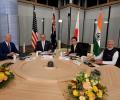
Saturday's Quad meeting in Delaware is taking place against the backdrop of China's assertive behaviour in the South China Sea, its sabre-rattling in the Taiwan Strait and increasing footprints in the Pacific and Indian Ocean, asserts Rup Narayan Das.

Forty-five specialists will soon be joining key posts of joint secretaries, directors and deputy secretaries in different central ministries as part of the Modi government's ambitious plan to infuse fresh talent to further improve ease of governance.

It is in circumstances like this that the Constitution becomes extremely important. It reminds us that we have a commitment towards higher human values to fulfil, a path to get back to, suggests Shyam G Menon.Else, we risk being rudderless in an ocean of money and majoritarianism, suggests Shyam G Menon.

Industry body CII on Thursday made a case for pushing reforms in sectors like land, labour, and agriculture by the Modi 3.0 government to accelerate economic growth, which is estimated to be around 8 per cent in the current financial year. CII president Sanjiv Puri said a lot of policy interventions in the past have put the economy on "a much stronger wicket". "The growth rate is poised to touch 8 per cent during the current year, marking the fourth consecutive year of above 7 per cent + growth.

The central government's Great Nicobar development project, proposed around an unprecedented transhipment port, will be executed to keep environmental impact minimal, and is essential as it is of national importance, the government has said amid calls to abort the controversial project due to ecological concerns, the Centre said in an official statement.

Is India headed there again? questions Ajit Balakrishnan

For India to view the new Sri Lankan leadership only through the prism of the past or through their narrow view on China, is fraught with possibilities that should be avoided, asserts N Sathiya Moorthy.

Hong Kong has the highest level of economic freedom worldwide

Among the 30 Sensex companies, Larsen & Toubro, Power Grid, NTPC, State Bank of India, Reliance Industries and HDFC Bank were the biggest laggards. Sun Pharma and Nestle were the only gainers.

Chaudhary Charan Singh, who on Friday was conferred with India's highest civilian award Bharat Ratna, is popularly known as a champion of farmers.

'Pakistan is a nuclear country.' 'With the kind of situation that is there in Pakistan today, America will help Pakistan stay afloat.'

Prime Minister Narendra Modi said the liberalisation of policies governing the acquisition and production of geospatial data is a "massive step in government's vision for an Aatmanirbhar Bharat". The reform will benefit country's farmers, start-ups, private sector, public sector and research institutions to drive innovations and build scalable solutions, he said.

The council wants the government to stick to its fiscal consolidation road map.

The current instability in the world is a result of long term systemic and socio-politico problems, points out Colonel Anil A Athale (retd).
'What can be applicable in Manipur may not make sense in Bengal'

Equity benchmark Nifty scaled the psychological milestone of 21,000 in afternoon trade on Friday, and the Sensex touched its all-time intraday high of 69,888.33 after the central bank's decision to keep policy rates unchanged in line with market expectations. The 50-share benchmark index opened on a bullish note, after taking a breather on Thursday, and rose to 21,006.10. As many as 25 stocks were trading in the green, and 24 stocks defied the broader market and were trading in the negative territory.

Meet Dr Aaron K Chatterji whose academic research, policy work and public service has been recognised by the international nonprofit organisation.
If the concerns over risking political capital are overcome, the long-term gains for the Indian economy will be immense, asserts A K Bhattacharya.

'it's not just youth in India who are left behind because of their inability to find jobs; nearly two-thirds of Indian women of working ages do not participate at all in the paid labour force.'

Equity benchmarks extended their decline for the fourth straight session on Wednesday, with the Sensex falling 214.85 points after the Reserve Bank raised the key interest rate by 50 basis points. Continuous foreign fund outflows and surging crude oil prices also weighed on markets. The 30-share BSE benchmark dropped 214.85 points or 0.39 per cent to settle at 54,892.49.

Sir Osborne Smith was the first governor of the Reserve Bank, serving from April 1, 1935, to June 30, 1937.
Reserve Bank Governor Shaktikanta Das has pitched for policy support from all sides -- fiscal, monetary and sectoral -- to nurture recovery of the economy hit by the second wave of the coronavirus pandemic. The dent on economic activity due to the second wave of the pandemic during April-May necessitated continuation of monetary measures to support the process of economic recovery to make it durable, Das had said while participating in the meeting of the Monetary Policy Committee (MPC) earlier in the month. "Overall, the second wave of COVID-19 has altered the near-term outlook, and policy support from all sides - fiscal, monetary and sectoral - is required to nurture recovery and expedite return to normalcy," Das said, as per the minutes of the meeting released on Friday.

'I found it unbelievable that L&T said 45,000 jobs were waiting to be filled because of unavailability of suitable skillsets.' 'So, when the Opposition sweepingly says there are no jobs, I'm sorry... I'm not saying it's raining jobs, but there are jobs. The (skill) gap has to be bridged.'

'Dynastic politics has become a tool of convenience for political parties. The BJP does not hesitate to accept it when it comes to its own alliance or party candidates. The same goes for the others.'
Against the Reserve Bank of India's (RBI's) projection of 7.1 per cent, India's first quarter (Q1) 2024-25 (FY25) gross domestic product (GDP) growth came in at 6.7 per cent. This is in line with market expectations and significantly lower than the 7.8 per cent recorded in the fourth quarter (Q4) 2023-24 (FY24) and 8.2 per cent in Q1FY24. The quarter witnessed decreased government consumption and investment spending due to the parliamentary election.
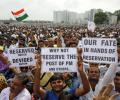
The bill, approved by the Union Cabinet on Monday, was brought in on the last day of the Winter Session of Lok Sabha.
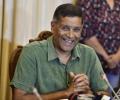
Rumours in the bureaucracy on his successor include the names of Sajjid Chinoy of JP Morgan, Rathin Roy of the National Institute of Public Finance and Policy, Neelkanth Mishra of Credit Suisse and the principal economic advisor, Sanjeev Sanyal.

An institution of national importance must reflect the "national structure", the Centre told the Supreme Court on Tuesday while pointing out that around 70 to 80 per cent students studying at Aligarh Muslim University (AMU) are Muslims even without reservation.

Quarterly earnings, global trends and trading activity of foreign investors will drive stock markets in this holiday-shortened week, analysts said. It will be a trading holiday on January 22, with the Maharashtra government announcing a holiday in connection with the consecration of the Ram Temple in Ayodhya. Equity markets would also remain closed on Friday for Republic Day.
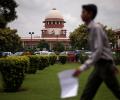
The Supreme Court, examining whether states can sub-classify Scheduled Castes and Scheduled Tribes for grant of quota inside quota, on Wednesday said all SCs and STs may not be homogeneous in terms of their sociological, economic, education and social status.
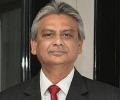
Patra, as executive director of the central bank, was the principal advisor to the Monetary Policy Department since July 2012.
 © 2026 Rediff.com - Advertise with us - Disclaimer - Privacy Policy - Sitemap - Feedback - About us - Terms of use - Grievances